The story of the Eckhardt family, from a German crest to a Chinese robot
I. The Grant — Germany, 17th century(family tradition)
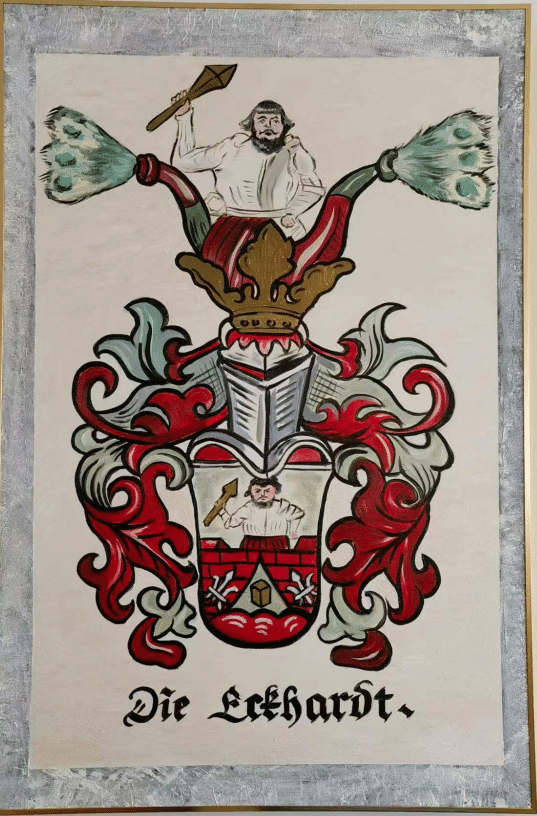
In the 1600s, in the German lands, the Eckhardt family was raised to nobility — and with the rank came the right every noble house treasured most: a crest that could be handed down. The painter asked the family: what are you? They answered in symbols. A wild man — the bearded figure of the old forests — strong enough to swing the club he raises, but standing not in the wilderness: he stands behind a wall. He is the protector on the rampart, the first to rise when danger comes. The red brick is not decoration; it is what the family builds and defends. The crossed silver hammers below speak the family’s real trade: craft — the hand that makes. And the golden cube on the green earth is what honest work yields. Under everything runs water, silver waves on red, because a family that trades and travels lives by rivers and seas. Above the helmet, the peacock feathers — in the old belief, the peacock’s flesh does not decay — stand for the one thing the family refused to let die: its name.
II. The Musician — Augsburg, 18th century
The name was carried into the age of music. Johann Gottfried Eckard, born in Augsburg in 1735, became one of the finest keyboard players in Europe, working alongside the great piano maker Andreas Stein. When Eckard died in Paris in 1809, the Mercure de France called him “the most celebrated harpsichordist of Europe.” The wild man had come down from the wall — and onto the stage.
III. The Piano Makers — Bad Dürkheim, 19th to 20th century(documented in the German trade registers)
Here the paper trail begins, and it leads to the workshops. In Friedhofstraße 14 in Bad Dürkheim, in the Palatinate, Stephan Eckhardt & Söhne are registered as Pianoforte-Fabrikanten around 1925; Carl Eckhardt runs a piano factory and dealership at the same address until about 1932. Across Germany, the name appears again and again in the instrument trade — Stuttgart, Hildburghausen, Flensburg, Sonderhausen, Quakenbrück. The crossed hammers on the shield, it turns out, were literal: the Eckhardts built pianos. Note by note, string by string, the golden cube grew in the workshops.
IV. Across the Water — the world, 19th to 20th century
The silver waves at the base of the shield were also literal. Like so many German families, Eckhardts crossed the Atlantic — passenger lists of the great emigration centuries carry the name to new continents, where branches of the family put down roots far from the Palatinate. The wall in the crest had been a home to defend; now the family carried its defense in its name alone. Wherever they landed, the pattern held: build something solid, work with the hands, keep the name alive. The crest’s peacock feather — incorruptibility — was proving itself. The family name survived distance, war, and the loss of everything that could not be carried.
V. The New Craft — Ningbo, China, 21st century
Four hundred years after the grant of arms, the wild man raised his club once more — and this time it was a robotic arm. In Ningbo, the Eckhardt brand was founded deliberately as the inheritor of the family name: coffee brewed not by hand alone but by a machine taught the barista’s craft — a robotic arm, a three-bean blend, water at exactly 92–94 degrees, every cup consistent, the pipes steam-cleaned after each pour. From pianofortes to coffee robots: the instrument changed, the craft did not. The family that once tuned strings now programs them into steel. The story was told on Chinese national television in a documentary on craftsmanship, and in March 2022 the family’s modern heir received what his 17th-century ancestors would have understood perfectly — official recognition from a foreign crown: permanent residence in China.
Epilogue — what the crest says
Read the shield in one glance: A strong man stands guard over what his family has built; his tools are craftsmanship; his reward is gold honestly earned; water carries his name across the world; and the peacock feather promises the name will not die.
Four centuries. Three continents. One crest.